
About Custonaci
Custonaci (Custunaci in Sicilian) is an Italian municipality with 5 499 inhabitants in the free municipal consortium of Trapani in Sicily.
Since August 26 2009, Custonaci has received, following an Episcopal Bull, due to its long expressed Marian devotion, the title of "Civitas Mariae". It is also called "International City of Marble" because in its territory there is the second largest marble basin in Europe, with about 100 active quarries and around fifty industrial plants.
Physical Geography
Located at the eastern end of the Gulf of Bonagia, Custonaci sits on a hill about 186 meters above sea level. It borders the municipalities of San Vito Lo Capo, Valderice, Buseto Palizzolo, and Castellammare del Golfo, and faces northwest onto the Tyrrhenian Sea, giving rise to the seaside district of Cornino. The territory of Custonaci is divided internally into characteristic districts of the town: Sperone, Assieni, Santa Lucia - Piano Alastre, Purgatorio, Baglio Messina, Baglio Mogli Belle, and Scurati.
History
According to a 1241 decree by King Frederick II of Swabia, thirteen "Casalia Inhabitata" were granted to the University of Monte San Giuliano (now Erice), with the aim of gathering the "habitatores" over a wide surrounding territory to increase the population. All this land, extending to Castellammare del Golfo, was divided into fiefs and given to the wealthiest Erice families for administration. The "Marble Riviera" included seven fiefs with thirty-six "parecchiate," or plots of land allowing agricultural cultivation, thus gathering a certain number of inhabitants.
Scattered throughout the territory, "bagli" were established, structures aimed at coordinating agricultural work. The feudal settlement, with the residential nucleus gradually forming around the sanctuary, became the current historic center of the town. One of the most important bagli in the territory is Baglio Cofano on Mount Cofano, owned by the Sanclemente and Maranzano families, abandoned at the end of World War II.
In the early 20th century, Custonaci was part of the municipality of Monte San Giuliano, which became Erice in 1934. After World War II, many urban centers had grown, and with its marble extraction activity, Custonaci became the first area of the Erice countryside to gain autonomy on December 25, 1948, followed in the subsequent years by Buseto Palizzolo, San Vito Lo Capo, and Valderice. The first mayor of Custonaci was Vito Cipolla, who today has a street in the town center named after him.
Monuments and Places of Interest
Mangiapane Cave in Scurati
In its territory are the Scurati Caves, an ancient prehistoric settlement, where for several years the "Living Nativity of Custonaci" has been held during the Christmas period.
A place of artistic and historical interest is the Sanctuary of Maria Santissima of Custonaci, around which small farming settlements gradually formed over the centuries, giving rise to the town. It was built around 1500. A beautiful rose window decorates the facade of the church. The sanctuary houses a 15th-century oil painting on wood depicting the Virgin about to nurse the Child, an object of devotion for the people of Custonaci and the surrounding villages. In addition, it preserves a tempera on wood from 1541, by the workshop of Crescenzio, depicting the Madonna on a throne with the Child.
Part of the municipality falls within the Monte Cofano natural reserve.
The Monte Cofano tuna fishery is also worth seeing.
In 2016, an Islamic granary and two astronomical monuments, nicknamed the "Horse of the Sun" and the "Gate of the Sun," were discovered, both located on Mount Sparagio.
The Madonna of Custonaci
Custonaci is "Civitas Mariae". The devotion to Maria Santissima of Custonaci is very strong, and she is also the patron of Erice and the entire Erice countryside. Tradition says it began after a French ship, carrying a painting of the Madonna with Child, survived a storm by invoking Maria Santissima and taking shelter in the Gulf of Cornino.
The painting is actually an oil on a gesso-prepared wood panel, dating back to the 15th century, from the school of Antonello da Messina, depicting the Madonna nursing the Child Jesus, preserved in the local sanctuary. The image was solemnly crowned by the Vatican Chapter in 1752 by Pope Clement XIII.
On August 26, 2009, after 73 years, the painting depicting the Madonna was carried in procession, in a deeply felt atmosphere by the people.
The Living Nativity
Every year, since 1983, during the Christmas period, the Living Nativity of Custonaci takes place in the Mangiapane Cave, an event among the 100 most beautiful events of Sicily.
The Mangiapane Cave is one of the most fascinating natural attractions of Custonaci, Sicily. Here are some detailed facts about the cave:
1. Location: The Mangiapane Cave of Custonaci is located near the Monte Cofano Natural Reserve, in a scenic natural environment offering stunning views of the sea and surrounding mountains.
2. Features: The Mangiapane Cave is of karstic origin and extends over 1,000 meters. Inside, visitors can admire stalactite and stalagmite formations, creating a unique atmosphere.
The cave is also an important archaeological site, with artifacts showing human presence dating back thousands of years.
3. History: The Mangiapane Cave has a very fascinating history. In the past, it was used as a refuge and home by local families until the 1950s. Inside, remains of ancient dwellings and tools have been found, indicating the presence of prehistoric humans.
4. Visits: Today, the Mangiapane Cave is open to visitors and offers a path to explore its history and natural features. It is recommended to visit with a guide available on site to fully appreciate its historical and cultural value.
5. Events: The Mangiapane Cave is also the setting for social, cultural, and folkloric events that celebrate local traditions and the connection of the Custonaci community with its heritage.
The Spincia Festival
Every year the “Spincia Fest” takes place, now in its 24th edition, in honor of the typical local dessert, the “sfincia”.
CUSTONACI – a treasure of a village
Custonaci… Welcome to a unique journey through nature, art, history, devotion, and gastronomy.
Explore the village of Custonaci and experience its wonders, and its Cornino, the marine paradise of Custonaci.
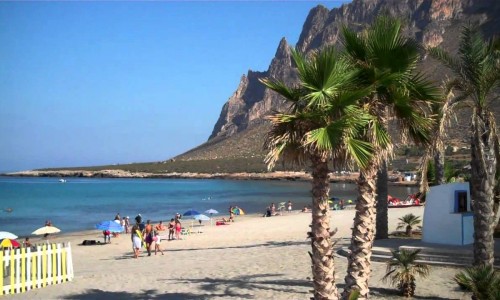
Cornino, the enchanting seaside hamlet of Custonaci, boasts a bay with golden sand, a summer destination for many bathers.
This marine paradise offers opportunities for water sports, boat excursions, and fishing in its rich seabed, as well as a wonderful floating walkway on the sea.
In the summer, Cornino comes alive with sporting events, tournaments, and excursions.
Discover Custonaci: timeless elegance Custonaci, in Sicily, welcomes you with timeless landscapes: the mighty Mount Erice to the south and the impressive Mount Cofano to the north dominate the Cornino Bay. Our sanctuary and marble quarries rise with grandeur. The sunset paints the landscape with magical colors, as rocks, vegetation, olive trees, and vines blend into an unforgettable scene.
History, nature, and archaeology intertwine – Experience the essence of Custonaci
Among Elymian roots, Phoenician influences, and an Arab touch, the town tells its story.
Nature offers masterpieces with the Monte Cofano Nature Reserve and Mount Sparagio, gifting spectacular landscapes.
The Monte Cofano Reserve is a true treasure chest, one of the most fascinating natural attractions of the area. Surrounded by silence and embraced by lush vegetation, it stands out for its massive rocks extending to the sea. In the countryside rise the “bagli”, ancient fortified rural structures with an inner courtyard.
Custonaci boasts a rich historical and cultural heritage, from prehistoric caves to steles with anthropomorphic figures. The many prehistoric caves reveal thousand-year-old secrets.
Among them, the most famous is the Mangiapane Cave, once home to a family who, in the early 1800s, transformed it into a small village that today becomes the stage of traditions, hosting the museum and the Living Nativity Scene.
In Custonaci, archaeological mysteries emerge, including the oldest Islamic granary, an archaeological site of great value.
There are also two imposing monoliths that mark the passage of time in harmony with solar alignment: the Sun Gate and the Sun Horse.
Custonaci is a sort of Sicilian Stonehenge, still waiting to be fully enhanced.
Art and monuments – Custonaci, a Marian land
In the heart of the village, art comes to life through the Madonna of Custonaci, a delicate panel painting from 1521.
Framed by angels and ribbed vases rich in ears of wheat, the Madonna on the throne with the Child is the center of devotion.
The apse of the Custonaci Sanctuary is imposing, with a Baroque marble tribune adorned with an Immaculate Virgin in marble from the Gagini school and four wooden statues by sculptor Pietro Cannamela.
Frescoes by Domenico La Bruna, paintings by Giuseppe Felici, and the pictorial decoration by Carlo Righetto enrich the sanctuary.
In the Cerriolo Park, a unique spiritual experience is revealed through a marble-station Via Crucis.
The Marian Sanctuary of Custonaci, dating back to the mid-1500s, symbol of ancient devotion and pilgrimage, features a facade with ogival arches.
The “Art and Faith” Museum preserves a precious 15th-century wooden shrine with the Madonna of Custonaci, processional banners, sculptures, paintings, and more.
The wooden case used in the traditional “transports” of the painting of the Madonna from Custonaci to Erice is a distinctive element of this tradition.
The eternal bond between Custonaci and the Madonna is celebrated each year with the evocative “Landing”.
Tradition tells that the Madonna arrived from the sea on a Venetian or French ship, surviving a shipwreck and landing at Cala Bukutu.
During the August festivities, a sailing ship arrives in the bay illuminated by fireworks, bringing ashore a copy of the sacred painting.
Faithful carrying torches accompany the image in procession to the Sanctuary, recalling this ancient event with devotion.
The presence of the Madonna of Custonaci permeates the land, from the “Regina Pacis” statue in Cerriolo Park to the “Stella Maris”, placed 13 meters deep in the waters opposite the Monte Cofano Nature Reserve.
Custonaci is a Civitas Mariae, a place marked by centuries-old Marian devotion.
Tradition and flavors – Taste the authenticity of Custonaci
Local cuisine features couscous, with sea bass, sea bream, tuna, and red shrimp prepared as succulent roasts, delicious dishes, and perfect fried specialties. Among the delicacies are “pane cunzato” and prized local meats, true gastronomic gems that tell the story of this marvelous land. Rural cuisine shines with ricotta-filled cassatelle in broth, roasted kid and lamb flavored with bay leaves and rosemary.
Desserts like “spince”, ricotta cassatelle, and pignolata delight the palate.
A culinary experience between sea and countryside, accompanied by fine olive oil and excellent local wine.
Economy and typical productions – The economic heart of Custonaci
The fine marbles of Custonaci are of great geological and economic importance. Used for centuries to adorn monumental works such as the Royal Palace of Caserta and St. Peter’s Basilica in Rome, they have gained worldwide fame.
The “Marble and Caves Museum” collects photographs and work tools used in the Custonaci marble quarries in the 1950s.
Agriculture and livestock, together with the tourism sector—hotels, B&Bs, hospitality facilities and tourist services—give strength and vitality to the economy of Custonaci.
Do you want to rent a car, scooter or e-bike in Custonaci? CLICK HERE FOR INFO
Looking for a private car transfer or a shared shuttle to Custonaci? CLICK HERE FOR INFO
