
About Erice
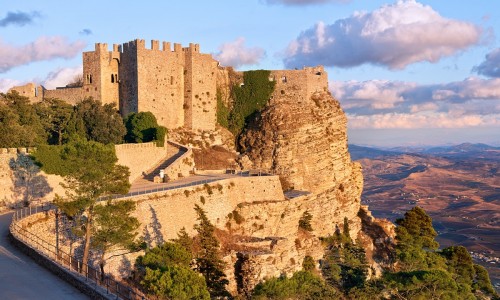
Erice (Erici or U Munti in Sicilian) is an Italian municipality with 27,317 inhabitants in the Free Municipal Consortium of Trapani in Sicily. From 1167 to 1934, it was called Monte San Giuliano.
In the town center, located on the summit of the homonymous Mount Erice, there are only 1,024 residents (a population that increases tenfold in the summer), while most of the population lives in the valley in Casa Santa, adjacent to the city of Trapani.
The name Erice comes from Erix, a mythological character, son of Aphrodite and Bute, killed by Hercules.
Monuments and places of interest
Cyclopean walls from the Elymian-Phoenician-Punic period - 8th/7th century BC
"Castle of Venus" - Norman castle of the 12th/13th century on the remains of the Roman temple of Venus Erycina
Castle and towers of Balio (medieval)
Torretta Pepoli
Balio Garden
Pepoli Castle (19th century)
Spanish Quarter
Municipal Museum "Antonio Cordici"
Municipal Library "Vito Carvini"
Porta Carmine
Porta Trapani
Parish churches
Real Chiesa Madrice (Cathedral)
Church of St. Cataldo
Church of St. Giuliano
Church of St. Antonio Abate
Confraternity churches
Church of St. John the Baptist
Church of St. Martin
Church of St. Ursula
Churches and convents of regular orders
Church and Convent of St. Francis of Assisi
Church and Convent of the Dominican friars of St. Dominic
Church and Convent of the Annunziata or del Carmine
Convents outside the walls
Church and Convent of the Capuchin fathers
Convent of Martogna of the third order of St. Francis
Urban churches, monasteries, and their churches
Church and Monastery of the Most Holy Savior
Church and Monastery of St. Peter
Church and Convent of the Minimi friars of St. Francis of Paola (ruined)
Church and Monastery of St. Teresa
Church and Monastery of St. Carlo
Church and Reclusory of Saints Rocco and Sebastian
Convent of the fathers of the third order of St. Francis
Church of St. Alberto dei Bianchi
Church of St. Catherine Virgin and Martyr
Church of St. Anthony of Padua
Holy Spirit Chapel
Church of St. Nicholas of Bari
Church of St. Clare
Chapel of Saints Philip and James (later called St. Crispino)
Chapel of St. Margaret Virgin and Martyr
Chapel of St. Mary of the Recommended or of the Snow
Chapel of Our Lady of Custonaci
Church of the Most Holy Sacrament
Church of St. Philip Apostle
Church of St. Isidore Agricola
Chapel of St. Agnes Virgin and Martyr
Casa Santa or di Sales
Chapel of St. Raphael Archangel
Church or Oratory of St. Alberto
Suburban churches
Church of Our Lady of Grace
Church of St. Olive (today of the Holy Cross)
Mountain churches
Sanctuary of St. Anne
Chapel of St. Elijah
Chapel of Our Lady of Piety
Church of St. Mary Magdalene
Chapel of St. Hippolytus Martyr
Chapel of St. Matthew Apostle and Evangelist
Ruined churches
Church of St. Christopher Martyr
Suburban chapel of St. Bartholomew Apostle
Church of St. Luke Evangelist
Chapel of St. Nicholas
Church of St. Mary of the Stair
Church of Our Lady of Grace
Chapel of St. Mary Major
Chapel of Saints Cosmas and Damian
Church of St. Christopher Martyr
Historic palaces
Palazzo Sales, 18th century, Via Vito Carvini
Palazzo Burgarella, 18th century, Via San Francesco
Palazzo La Porta, 18th century, Via Vittorio Emanuele II
Palazzo Platamone, 14th-19th century, Via Vittorio Emanuele II
Palazzo Coppola, 19th century, Via Vittorio Emanuele II
Palazzo Chiaramonte (later convent of St. Dominic), 14th century, Via Vittorio Emanuele II
Palazzo Ventimiglia (later convent of St. Francis), 14th century, Via San Francesco
Palazzo Majorana, 18th-19th century, Piazza San Domenico
Municipal Palace (former Palazzo Giuratorio), Piazza Umberto I (seat of Museum "Antonio Cordici")
Rural estates
Baglio San Matteo (agro-forestry museum)
Baglio Adragna, 19th century
Case Giliberti, 19th century
Traditions and folklore
Procession of the Mysteries of Erice, held on Good Friday, with 19th century floats carried on shoulders
Artisan crafts
Ceramics - Carpets
Typical sweets
Erice bites, marzipan sweets with a core of citron jam and liqueur
Genoese cream, shortcrust pastry sweet with powdered sugar on top
Mustaccioli, ancient biscuits made in a former cloistered convent