
About Palermo City
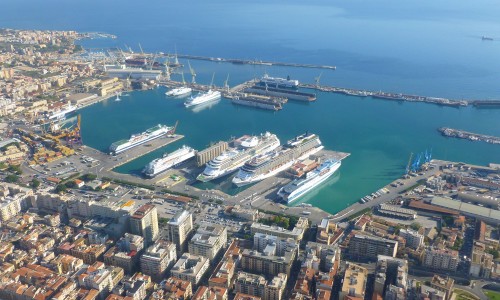
The port of Palermo is one of the largest ports for passenger traffic and in size in the Mediterranean. It extends eastward for several kilometers from Via Francesco Crispi (near the ancient small harbor of the Cala), including the maritime areas of Arenella and Acqua Santa.
Origins
The origins of the port of Palermo overlap with those of the city, because it was the port itself that was the central fulcrum of the citys development. The Phoenician sailors who founded it chose it for the shape of its inlet, and the Greeks called the city Panormos, meaning "all port". It was at the center of commercial exchanges for the Phoenicians, Carthaginians, Romans, and Arabs during the Muslim rule of Sicily.
Past
The current port of Palermo began in 1567 by will of the Viceroy of Sicily Garcia de Toledo when the ancient port of the Cala became insufficient and too narrow for the growing needs of the city. Since the south side of the Cala was occupied by the seafront promenade, the north side of the city near the new district of Santa Lucia (the current Borgo Vecchio), founded by Carlo d Aragona Tagliavia in 1570, was chosen as the development area. The district then developed a typically maritime character.
In 1590, when the works of the New Pier were completed, a stone marker was placed at the entrance of the port to commemorate its construction. The marker, topped by the eagle of Palermo, shows on one of its four sides the coat of arms of Viceroy Garcia de Toledo, and on another side the oldest existing depiction of the Genius of Palermo.
The port area continued to expand northward with the creation of the shipyards in the nineteenth century, reaching the port of Acquasanta.
In the early twentieth century, it was connected by a railway track to the central station; this track was later removed and replaced with a wider underground connection, allowing access also to Notarbartolo station.
Present
View of the port from the sea
It is connected with regular ferry services to Naples, Livorno, Cagliari, Civitavecchia, Genoa, Tunis, and less frequently to several other Italian and Mediterranean destinations. It is also connected by hydrofoils to the Aeolian Islands and the island of Ustica. It also hosts considerable freight traffic with the movement of containers arriving via Gioia Tauro from all parts of the world and destined for the whole Sicilian territory. Within the port there are the Palermo shipyards, among the few existing in the southern Mediterranean. The shipyards are owned by Fincantieri, which assigns to Palermo the task of building and refitting passenger and cargo ships. It is one of the most important ports in the Mediterranean for cruise traffic.
Future
The berths for cruise ships
The new Port Master Plan has recently been approved, providing for the development of the port over the next ten years. In this plan there is an almost complete relocation of the freight sector, which will be moved to Termini Imerese, while the port of Palermo will develop in the tourism and cruise sectors.
In particular, the plan foresees the creation of a large urban archaeological park, marina clubs, the removal of the barriers separating the port from the city, the renovation of internal and external road systems, and a new modern maritime station. Regarding the external connections, the creation of a tunnel linking the port with the ring road is planned, as well as two roundabouts at the entrances of the port and a station of the metropolitan rail service.
Berths
The port currently has the following operational berths:
6 for large capacity ships
1 for large capacity container ships
2 for feeder ships
8 for medium capacity RO-RO ships
8 for medium capacity conventional ships
Main Connections
An image of the port of Palermo
The main destinations from the port of Palermo are:
Genoa via Grandi Navi Veloci
Naples via Tirrenia and Grandi Navi Veloci
Livorno via Grimaldi Lines
Civitavecchia via Grandi Navi Veloci
Cagliari via Tirrenia
Salerno via Grimaldi Lines
Aeolian Islands via Ustica Lines
Ustica via Siremar and Ustica Lines
Tunis via Grandi Navi Veloci and Grimaldi Lines
Milazzo via Ustica Lines
Cefalu via Ustica Lines